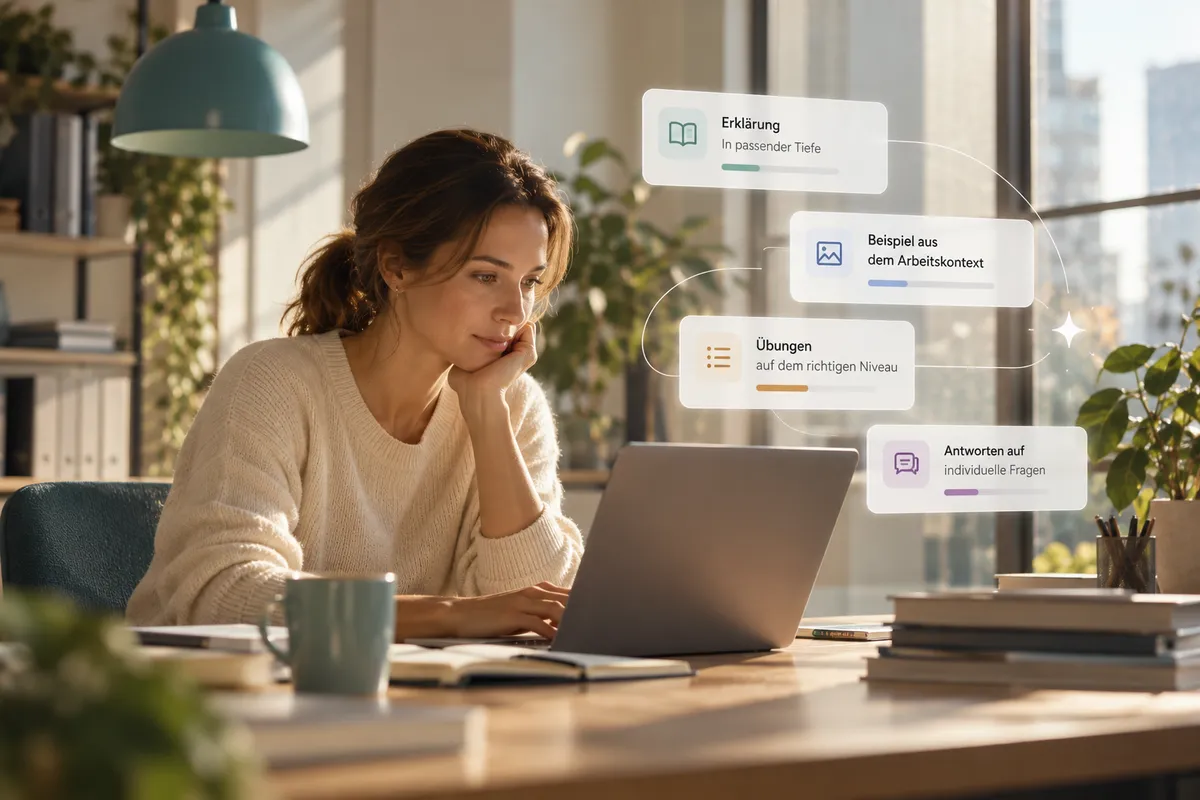

Why people development needs to adapt as quickly as the business it supports.
Businesses are changing faster than their workforces can adapt.
AI is reshaping how people prepare, decide, communicate and complete everyday tasks. Business priorities shift. New tools enter workflows. Teams discover new use cases before the organization has defined what they mean for every role.
Yet people development often follows a different logic.
Define a learning objective. Build a curriculum. Launch a program. Assign courses. Track completion.
This approach can work when requirements are stable.
But what happens when the work changes before employees have completed the development program designed for them?
The challenge is not simply to create better training. It is to build people development that can adapt as the business changes.
Work Changes in Smaller Steps
When organizations introduce AI, they often start by asking a familiar question:
Which roles will change?
It seems like the logical place to begin. Job titles define responsibilities, career paths and development programs. If a role changes, then L&D can create the right learning path for it.
But that is rarely how change happens in practice.
AI does not usually transform an entire role overnight. It changes individual tasks first.
A sales representative may use AI to prepare for customer meetings. A manager may use it to structure feedback. A customer support employee may use it to summarize complex cases. A marketing team may use it to develop first drafts, analyze customer feedback or adapt campaign materials.
The job title stays the same.
But the work inside the role starts to change.
And that creates a challenge for L&D: By the time a role has formally changed, employees may already have spent months working in new ways.
The real challenge is not simply preparing people for new jobs. It is helping them adapt as their current work changes.
Why Fixed Curricula Fall Behind
Courses, campaigns and fixed learning paths can be valuable. They provide structure, communicate important information and work well for topics with standardized requirements.
But they have limits when the work itself is changing in real time.
A fixed curriculum is based on what the organization knows at the moment it is designed.
It may reflect the right priorities in January. But by April, teams may be using different tools, facing new customer questions or developing entirely new ways of working.
The curriculum is not necessarily wrong. It may still provide useful foundations.
But it cannot automatically respond to what each employee needs next.
A person who is already using AI confidently may need help applying it to complex customer situations. Someone else in the same role may still need to understand the basics. A team leader may need to learn how to coach their team through new workflows and changing expectations.
Giving all three employees the same course does not reflect the reality of their work.
From Job-Based Training to Adaptive People Development
This is where L&D needs a different starting point.
Instead of asking only, “What should this role learn?”, organizations need to ask:
Which tasks are changing, what capabilities do they now require, and who needs support right now?
That requires people development to move closer to the work itself.
If a business priority changes, employees need relevant support when that change begins to affect their day-to-day tasks — not months later, when a new program is ready to launch.
For example, a company may decide to use AI to improve sales preparation.
The change is not simply that sales representatives need an AI course.
They may need to learn how to:
- evaluate AI-generated account research;
- recognize inaccurate or incomplete information;
- turn insights into relevant customer questions;
- adapt their preparation to different customer situations; and
- apply their own judgment when an AI recommendation does not fit.
These are not just tool skills. They are capabilities developed through learning, practice, feedback and reflection.
Development That Adapts as the Business Changes
Adaptive people development does not replace learning design with automation.
It gives learning design a more active role.
The organization still defines its business priorities, trusted knowledge sources, objectives and quality standards. But instead of translating them into one fixed program for everyone, a fully automated development system can continuously turn those priorities into relevant support for individual employees.
The process becomes more dynamic:
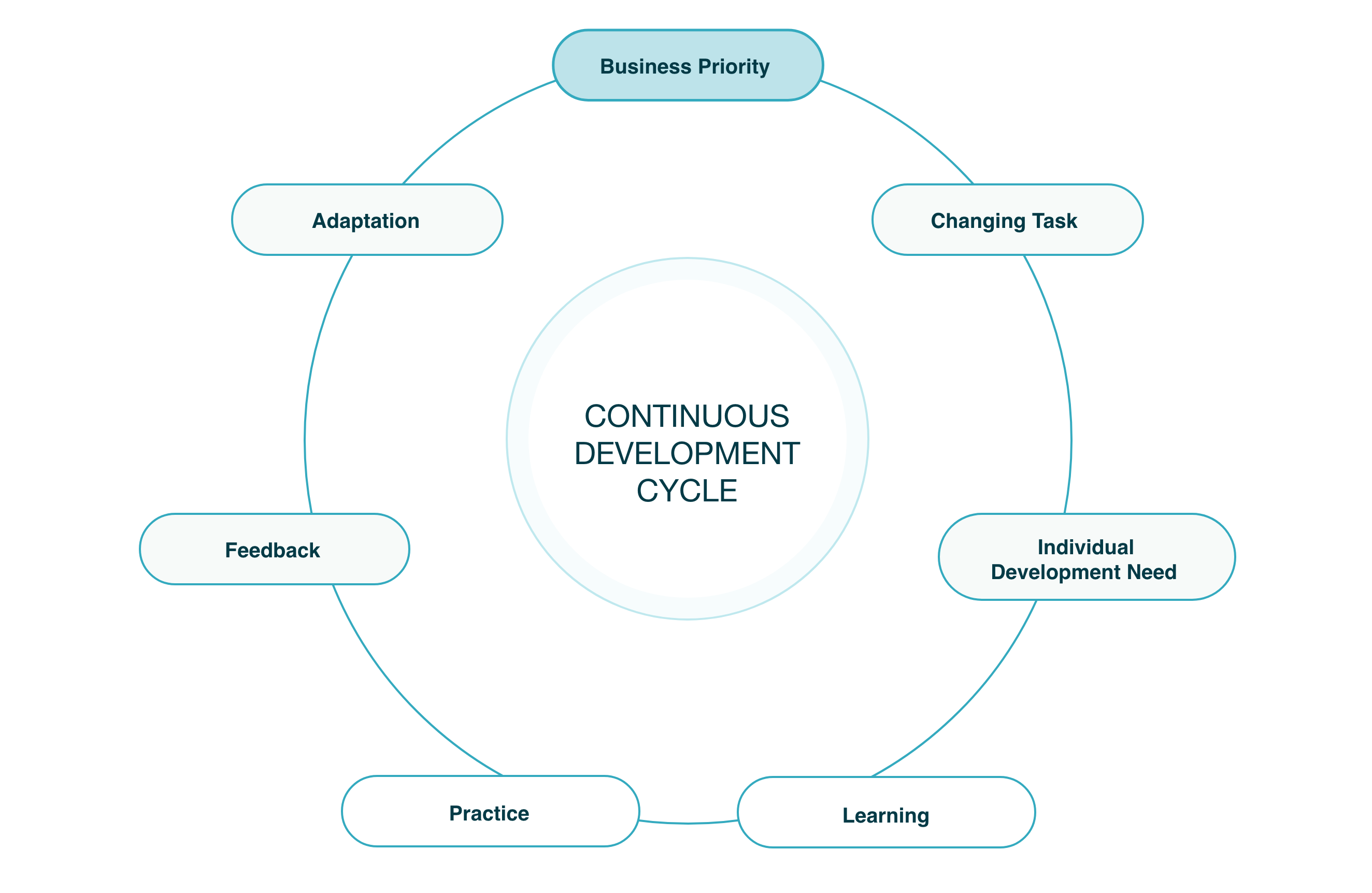
When a new priority emerges, employees receive development support that reflects their role, existing knowledge and current challenges.
When they demonstrate progress, their next steps can evolve.
When the business changes again, the development journey changes with it.
This makes people development more responsive without making it less structured. The structure simply shifts away from a predefined course sequence and towards the capabilities the business needs people to build.
You do not need to know today what everyone needs to learn tomorrow. Your people development can adapt as your business changes.
Supporting the Individual, Not Just the Program
The value of adaptive systems lies in their ability to recognize that employees do not experience change in the same way.
Two people may have the same job title but need completely different support.
One employee may be ready to practice a new workflow in a realistic scenario. Another may need foundational knowledge. A third may need feedback after applying a new approach in their daily work.
Static programs tend to organize development around the program itself: the launch date, the course catalogue or the campaign schedule.
Adaptive people development organizes it around the employee and the work they need to do.
That is especially important when AI is changing work faster than formal role structures can keep up.
The goal is not to create more content every time something changes.
It is to make relevant development available when the change becomes real.
Making Workforce Readiness Visible
This also changes what L&D should measure.
Course completion can show whether people have participated. Campaign engagement can show whether people have noticed a new initiative.
But neither tells the organization whether employees are able to work effectively in a changing environment.
A more useful question is:
Can people apply the capabilities the business needs as their tasks and workflows evolve?
Making workforce readiness visible means understanding where people are developing the required capabilities, where they need more practice or support, and where changing priorities are creating new development needs.
That connects people development directly to business transformation — not as a one-time response to a new job title, but as a continuous process that helps people keep up with changing work.
Development That Moves With the Business
AI will continue to change how work gets done, often in small steps before those changes become visible in organizational charts.
Waiting for new roles before supporting development is no longer enough.
Organizations need people development that can respond to changing priorities in real time, support individual employees with relevant learning, practice and feedback, and make workforce readiness visible as work evolves.
Because when tasks change faster than job titles, people development needs to move faster too.
At chunkx, we are building fully automated people development journeys that continuously adapt to changing business priorities and each employee’s needs — while making workforce readiness visible. Discover chunkx.