
AI upskilling has become a priority for many organizations. But there is a fundamental problem: How do you train employees for technology that is changing faster than most training programs can be built?
The AI tools employees use today may look different six months from now. New use cases emerge, workflows change, and the skills needed in one role can be very different from those needed in another.
Trying to predict the perfect AI curriculum is therefore difficult. A better question is: how do you build an upskilling approach that can adapt as quickly as the skills employees need?
Don’t build your strategy around today’s tools
It is tempting to start AI upskilling with tools: How do we use ChatGPT? How do we write better prompts? How does Copilot work? These skills can be useful, but they can also become outdated quickly.
A more sustainable strategy separates stable capabilities from changing capabilities. Employees will continue to need a basic understanding of how AI works, how to critically evaluate its output, how to recognize limitations, and how to use it responsibly. What changes much faster is how AI is applied in a specific role.
A salesperson might need to learn how to prepare for customer conversations with AI. Someone in HR might use it to structure information. A manager may need to evaluate AI-generated recommendations.
The foundation can be trained. The application needs to be contextual.
Not everyone needs the same AI skills
A company may have thousands of employees with different roles, existing knowledge, and use cases. Giving everyone the same AI course is unlikely to prepare everyone equally well.
Instead of asking “What should our employees learn about AI?”, organizations can ask: “What does this person need to be able to do with AI in their role?”
That changes how learning is designed. The role provides context. Existing knowledge determines the starting point. Real use cases show what needs to be practiced. And as those factors change, the learning need changes with them.
Move from AI training to continuous AI upskilling
Traditional training assumes that we can define what someone needs to know, create the content, and consider the job done once the training is completed. That becomes difficult when the subject itself keeps changing.
AI upskilling therefore needs to become a continuous process:
Assess → Learn → Apply → Practice → Reassess → Adapt
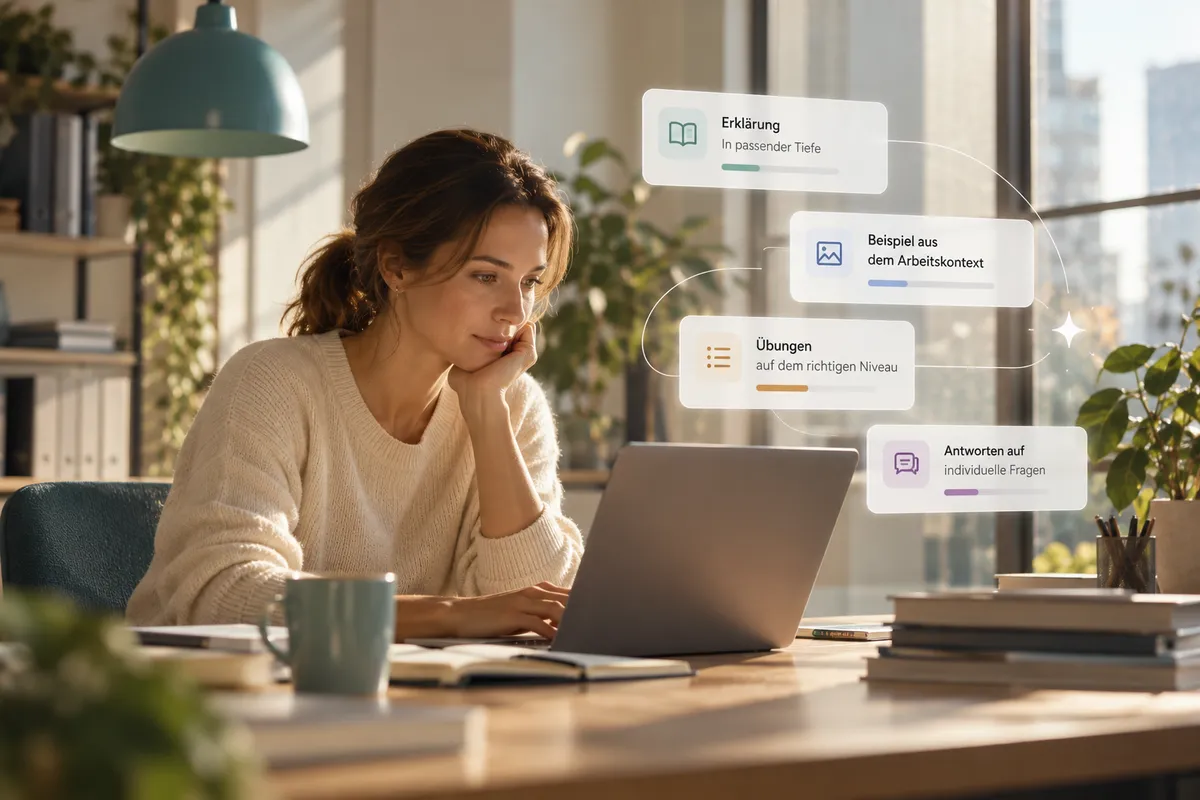
Someone who already understands a concept should not have to repeat it. Someone struggling to apply it may need another explanation. Someone who understands the theory may need practice in a realistic situation. And when a new AI use case becomes relevant to their role, the learning process needs to respond again.
In an uncertain environment, the learning system needs to adapt faster than the curriculum can.
Let employees practice, not just learn about AI
Knowing what AI can do is different from being able to use it well. Employees need opportunities to apply AI to realistic situations: deciding when to use it, asking the right questions, evaluating its output, identifying mistakes, and knowing when human judgment is required.
Instead of only explaining good AI use, learning can ask employees to demonstrate it. They can work through scenarios, make decisions, receive feedback, and try again.
This is where AI upskilling moves from knowledge to capability.
Measure readiness, not completion
A completion rate can tell us how many employees finished a course. It cannot tell us whether they can apply what they learned.
More useful questions are: Can employees use AI effectively in their role? Can they recognize when an AI-generated answer needs to be questioned? Can they apply AI within the organization’s rules and context? Where do they still need explanation or practice?
The answers to those questions can become the starting point for what happens next.
Build for change, not certainty
An AI upskilling strategy does not need to predict every tool employees will use or every skill they will need in the future.
It needs a stable framework for what matters to the organization while allowing learning to continuously adapt to roles, existing knowledge, new use cases, and individual needs.
That means moving away from one curriculum for everyone and towards a system that can continuously identify learning needs, create relevant learning experiences, provide opportunities to practice, learn from interactions, and determine what should happen next.
The goal isn’t to build the perfect AI training program for today. It’s to build a learning system that can keep up with tomorrow.
Want to explore what an adaptive AI upskilling approach could look like for your organization? In a demo, we can discuss your use case, learning goals, and how continuous, role-specific learning can be built from your own company knowledge.