AI capabilities that keep pace with the evolution of AI.
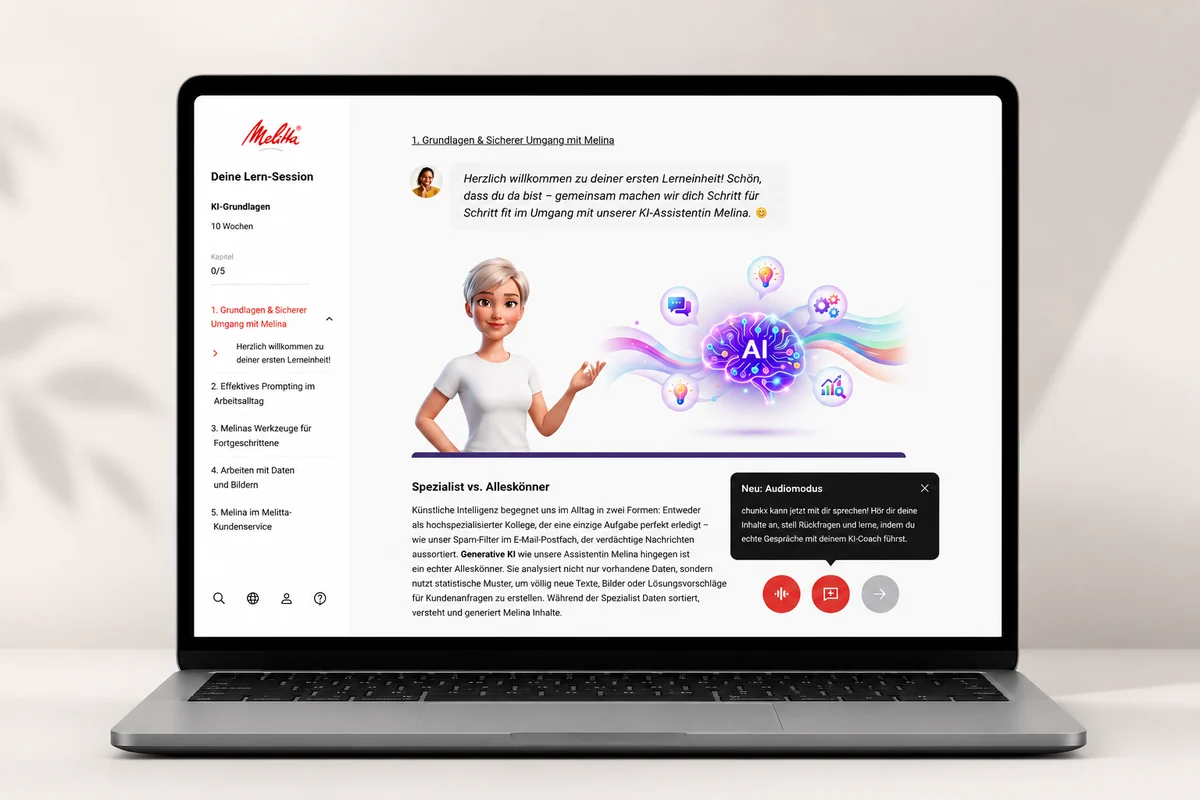
As an AI-powered learning platform, chunkx transforms your AI guidelines, tools and use cases into personalized learning content, practical exercises and AI coaching—tailored to each employee’s role, prior knowledge and specific use of AI in their daily work.
One AI training doesn’t create an AI-ready workforce.
AI is evolving faster than traditional training programs. New tools, use cases and requirements emerge continuously. At the same time, not every employee needs the same AI capabilities.
AI literacy looks different for every role
Someone using AI in marketing needs different capabilities than someone in HR, sales or IT. Standardized AI training may cover the basics, but it can only go so far in addressing different roles, levels of prior knowledge and real-world use cases.
AI capabilities need to evolve with the technology
One-time training is not enough when technology and use cases are constantly changing. Employees need to understand new possibilities, assess risks and repeatedly practice using AI safely.
AI upskilling that grows with your organization
Replace one-time AI training with continuous, personalized AI upskilling that adapts to roles, capabilities and new requirements.
Why chunkx
Turn your AI knowledge into safe, confident application at work.
chunkx transforms your AI guidelines, tools and use cases into personalized learning content that reaches employees exactly when they need to apply AI in their daily work.
Build the right AI capabilities for every role
Not everyone needs to know the same things about AI. chunkx adapts learning content to each person's role, prior knowledge and area of application—from foundational understanding to the safe use of specific AI tools.
On track
Turn your AI guidelines into practical knowledge
Transform internal AI guidelines, policies, tool guides and best practices into personalized learning content that employees can understand and apply in their daily work.
DOC
AI
Practice using AI instead of just learning about it
Let employees practice real situations, decisions and use cases. Interactive exercises and AI-powered scenarios help turn knowledge into safe application.
Make AI readiness visible
Identify knowledge gaps and track the development of AI capabilities across roles, teams and business units.
More AI capability. Less training effort.
80% less effort creating training
Automatically transform existing AI guidelines, internal documents and expert knowledge into personalized learning experiences.
Individual for every employee
Instead of one AI course for everyone, each employee receives content tailored to their role, prior knowledge and individual learning needs.
Continuous, not one-off
Update knowledge and learning content when tools, guidelines or use cases change—without having to build a new training program every time.
Continuous Development
From understanding AI to using it safely.
AI literacy means more than knowing what artificial intelligence is. Employees need to understand the opportunities and risks of AI and use it competently in their own work context.
1. Understand
Create a shared foundation for working with AI
Build understanding of AI, generative AI, its opportunities, limitations and risks—tailored to what your employees already know.
2. Apply
Develop AI capabilities for everyday work
Show employees the tools and use cases that matter for their role, and let them practice concrete application scenarios.
3. Act Safely
Turn guidelines and risks into real decisions
Train responsible handling of data, outputs and AI systems through realistic situations from everyday work.
4. Keep Developing
Keep AI capabilities continuously up to date
New tools, internal rules and best practices become new learning prompts. That way, your organization's AI literacy evolves alongside the technology.
AI literacy is more than a compliance requirement.
The EU AI Act makes AI literacy a responsibility for organizations that use AI. For employees to use AI safely and effectively in their daily work, they need more than a policy on the intranet: they need guidance, practice and knowledge that fits their role.
The right measures depend on how AI is used—from the tools and risks involved to employees’ roles, prior knowledge and work context.
chunkx transforms your AI guidelines, tools and use cases into personalized learning content, practical exercises and continuous learning prompts. This turns a regulatory requirement into AI capability that works in everyday practice.
Customer Story
AI capability that works in everyday practice
See how the Melitta Group continuously develops product knowledge, sales enablement and AI learning.
Rather than creating new training programs for every target group, Melitta transforms existing documents, presentations and AI knowledge into personalized microlearning. This keeps employees up to date on new products, services and AI topics in ways that matter for their role.
“[…] chunkx inspires us with the ability to make learning journeys self-directed and personalized: interactive, AI-supported and in real time.”
Solutions
Explore Other Use Cases
Now
HR & Onboarding
Employee Onboarding
Help new employees become productive faster with personalized onboarding content tailored to their skill level.
Frequently Asked Questions About AI Upskilling and AI Literacy
AI literacy refers to the skills, knowledge and understanding people need to use AI systems in an informed way and assess their opportunities, risks and potential impact. For organizations, this means employees should not only understand AI fundamentals, but also know how to use AI safely and effectively in their specific work context.
AI upskilling is the targeted development of employees' AI capabilities. Depending on the role, this may include foundational AI knowledge, working with generative AI and AI tools, prompting, evaluating AI outputs, and using AI safely and responsibly in daily work.
Article 4 of the EU AI Act requires providers and deployers of AI systems to take measures that support the development of AI literacy among their employees and other people who use AI systems on their behalf. These measures should take into account existing technical knowledge, experience, education and training, as well as the specific context in which AI is used.
A one-time training session can provide the basics. But because AI tools, internal policies and use cases are constantly changing, AI upskilling should be treated as a continuous development process. Regular learning prompts and practical application help employees build and maintain AI capabilities over time.
Yes. Learning content can be personalized based on role, prior knowledge, learning needs and area of application. This means employees in HR, sales, marketing or leadership can receive different content and practice tailored to their needs.
Yes. Internal AI guidelines, policies, tool documentation, presentations and best practices can serve as the foundation for learning content. This means employees learn not only general AI fundamentals, but also how to use AI within the specific framework of your organization.
Yes. Capability assessments and learning data make knowledge gaps and development progress visible. This enables organizations to understand where AI capabilities already exist and where teams or topics require further development.
Ready to embed AI capability into everyday work?
Transform your AI guidelines, tools and use cases into personalized learning experiences that continuously develop AI capabilities—so employees can use AI safely, effectively and productively in their daily work.
We use cookies to operate our website, to analyse its use (statistics) and for marketing. Necessary cookies are always active — you decide which other categories to allow. Privacy policy · Cookie policy
Cookie settings
Choose which categories of cookies you allow. You can change this at any time.
These cookies are required for the website to work, e.g. to remember your cookie choice. They cannot be disabled.
Help us understand how visitors use the website by collecting and reporting usage information in pseudonymised form (e.g. Google Analytics).
Used to recognise visitors and make our outreach more relevant (e.g. lemlist website pixel).